Benchmarks
A benchmark evaluates multiple models on multiple tasks and compares their
scores. It is a loop over task.evaluate(model) plus a result object that
knows how to rank, pivot, plot, merge, and save.
Custom benchmark
CustomBenchmark takes your models and tasks. Interfaces mix freely; here a
local transformers checkpoint runs against an API model:
from transformers import AutoModelForCausalLM, AutoTokenizer

from parsbench.benchmarks import CustomBenchmark
from parsbench.models import OpenAIModel, PreTrainedTransformerModel
from parsbench.tasks import ParsiNLUMultipleChoice, PersianMath, ParsiNLUReadingComprehension

# Create models
model = AutoModelForCausalLM.from_pretrained(
    "Qwen/Qwen2-72B-Instruct",
    torch_dtype="auto",
    device_map="auto"
)
tokenizer = AutoTokenizer.from_pretrained("Qwen/Qwen2-72B-Instruct")
qwen2_model = PreTrainedTransformerModel(model=model, tokenizer=tokenizer)

aya_model = OpenAIModel(
    api_base_url="http://localhost:11434/v1/",
    api_secret_key="ollama",
    model="aya:latest",
)

# Run the benchmark
benchmark = CustomBenchmark(
    models=[qwen2_model, aya_model],
    tasks=[
        ParsiNLUMultipleChoice,
        ParsiNLUReadingComprehension,
        PersianMath,
    ],
)
result = benchmark.run(
    prompt_lang="fa",
    prompt_shots=[0, 3],
    n_first=100,
    sort_by_score=True,
)
run() accepts the same evaluation parameters as task.evaluate()
(n_first, skip_existing_matches, prefer_concurrency, n_workers, the
save flags), plus sort_by_score= to rank models by average score in the
result.
There is also ParsiNLUBenchmark, a CustomBenchmark subclass hard-wired
to the ParsiNLU task set.
Full benchmark
To benchmark on every task in the framework, use load_all_tasks:
from parsbench.benchmarks import CustomBenchmark
from parsbench.models import OpenAIModel
from parsbench.tasks.utils import load_all_tasks

aya_model = OpenAIModel(
    api_base_url="http://localhost:11434/v1/",
    api_secret_key="ollama",
    model="aya:latest",
)

benchmark = CustomBenchmark(
    models=[aya_model],
    tasks=load_all_tasks(),
)
result = benchmark.run(
    prompt_lang="fa",
    prompt_shots=[0, 3],
    n_first=100,
    sort_by_score=True,
)
Benchmark result
BenchmarkResult holds every evaluation result for every model. Convert it
to a pandas DataFrame with to_pandas(); to_pandas(pivot=True) gives the
models-as-columns pivot table:
print(result.to_pandas(pivot=True))
Output:
                                                                                     score
model_name                                                                     qwen2:latest
n_shots                                                                                   0         3
task_category task_name                      sub_task         score_name
classic       ParsiNLU Reading Comprehension NaN              Common Tokens         0.46231  0.588274
knowledge     ParsiNLU Multiple Choice       common_knowledge Exact Match           0.30000  0.000000
                                             literature       Exact Match           0.20000  0.428571
                                             math_and_logic   Exact Match           0.60000  0.285714
math          Persian Math                   NaN              Math Equivalence      0.00000  0.142857
It renders best in a Jupyter notebook.
Plots
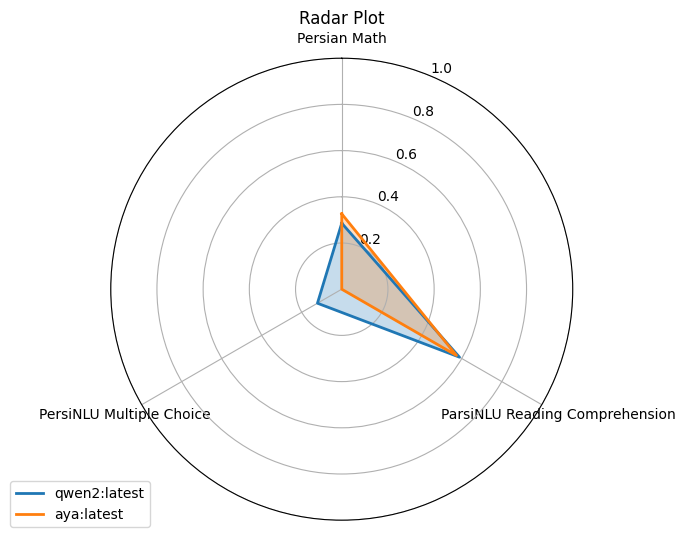
show_radar_plot() compares models across task categories;
show_bar_plot() shows the same data as bars:
result.show_radar_plot()
result.show_bar_plot()
Saving results
Set save_matches, save_evaluation, and save_benchmark to write matches,
per-task evaluations, and the combined benchmark file during the run:
benchmark = CustomBenchmark(
    models=[aya_model, qwen2_model],
    tasks=[PersianMath, FarsTailEntailment],
)
result = benchmark.run(
    prompt_lang="fa",
    prompt_shots=[0, 5],
    n_first=100,
    save_matches=True,
    save_evaluation=True,
    save_benchmark=True,
    output_path="results",
    sort_by_score=True,
)
The output directory structure:
results
├── aya:latest
│   ├── FarsTail_Entailment
│   │   ├── evaluation.jsonl
│   │   ├── matches_0_shot.jsonl
│   │   └── matches_5_shot.jsonl
│   └── Persian_Math
│       ├── evaluation.jsonl
│       ├── matches_0_shot.jsonl
│       └── matches_5_shot.jsonl
├── qwen2:latest
│   ├── FarsTail_Entailment
│   │   ├── evaluation.jsonl
│   │   ├── matches_0_shot.jsonl
│   │   └── matches_5_shot.jsonl
│   └── Persian_Math
│       ├── evaluation.jsonl
│       ├── matches_0_shot.jsonl
│       └── matches_5_shot.jsonl
└── benchmark.jsonl
Rebuilding and merging results
Three helpers cover the "I ran benchmarks last week and want to work with them now" cases:
from parsbench.benchmarks import BenchmarkResult, merge_benchmark_results

# rebuild a result from saved matches files (rescore=True re-runs the scorers)
result = BenchmarkResult.from_matches_files("results/", rescore=False)

# combine runs done at different times / on different machines
merged = merge_benchmark_results([result_a, result_b], sort=True)
merge_benchmark_results drops duplicate model names by default; pass
keep_duplicates=True to keep them all.
Building a leaderboard
build_leaderboard_from_benchmark writes the request/result file layout
used by the
ParsBench Leaderboard
HuggingFace space:
from parsbench.benchmarks import build_leaderboard_from_benchmark

build_leaderboard_from_benchmark(result, "leaderboard_data/")